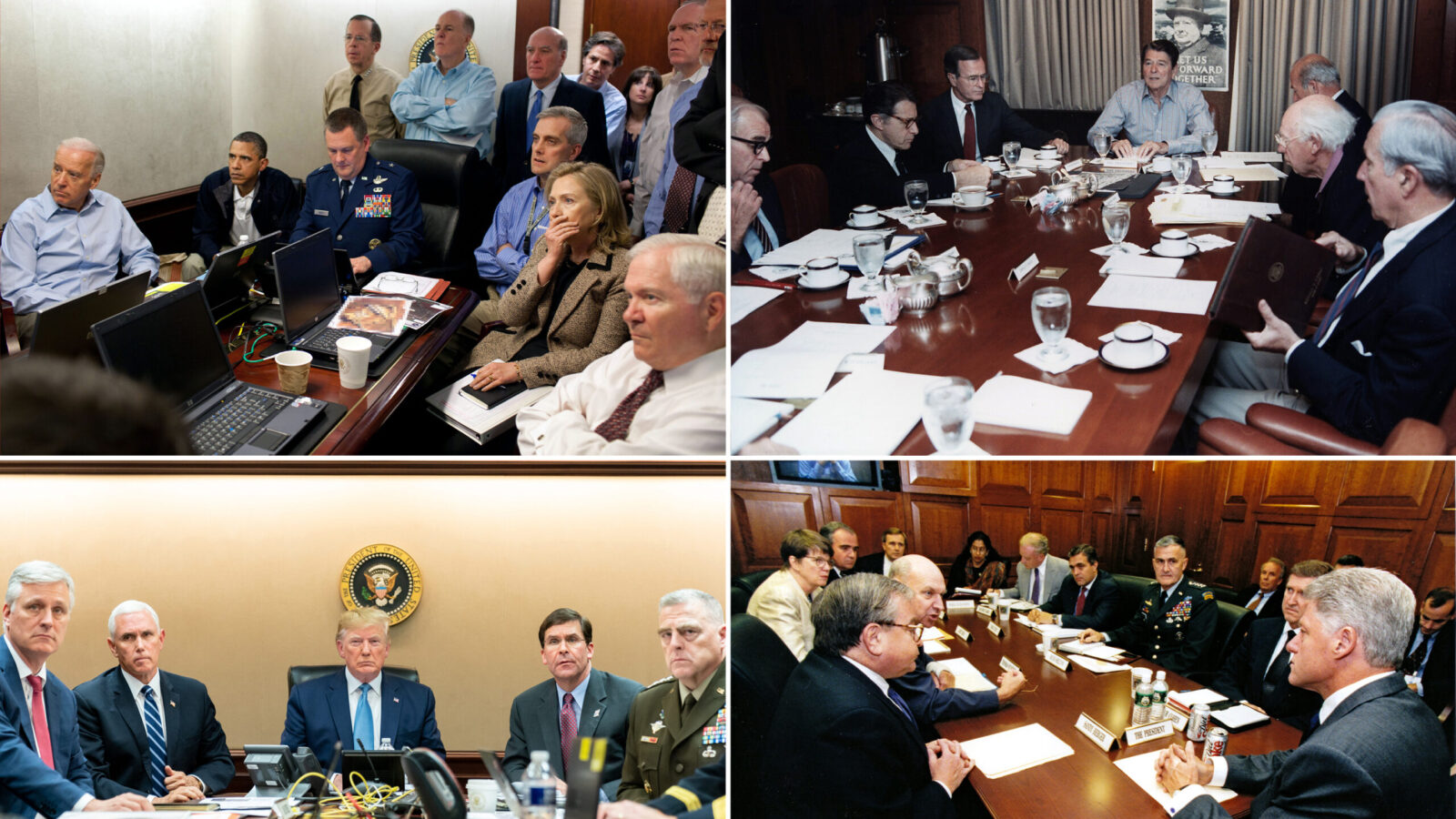
On May 1, 2011, President Obama, his staff and military brass watched the raid to on Osama bin Laden’s Pakistan compound while crowded tightly together in the Situation Room, the sequestered complex in the White House basement.
Official White House photographer Pete Souza captured the iconic moment, but it only happened because of technical difficulties.
Obama was originally alone as the mission took place, getting updates in a large conference room — despite its singular name, the Situation Room is actually several conference rooms and offices.
But, the tech crew couldn’t figure out how to patch in a live video feed of the mission to that particular room, so the president watched history unfold with the rest of those assembled.
That’s “how you end up with this rather clown-car-like image of everyone trying to cram into the small room — because no one can quite figure out how to move the video over to the big room,” former National Counterterrorism Center director Mike Leiter tells George Stephanopoulos in his fascinating new book “The Situation Room: The Inside Story of Presidents in Crisis” (Grand Central Publishing), out May 14th.
When most people think of the Situation Room, they imagine something full of grandeur and mystique, like the epic war rooms depicted in movies such as “Dr. Strangelove,” but Stephanopoulos reveals it to be paradox.
It “has been the crisis center during America’s catastrophes,” where some of the world’s most “sensitive and sometimes scary information” has been shared, he writes. But the 5,500-square foot Situation Room is also, physically, a “mundane place” that’s not above technical issues.
Though the idea for the Situation Room was first suggested to President Eisenhower in the 1950s, it was John F. Kennedy who acted on it, less than two weeks after the disastrous Bay of Pigs invasion in 1961.
A location was picked — an old bowling alley below the West Wing — and several names were suggested, from “Nerve Center” to “Executive Coordination Center.” Kennedy ultimately picked a moniker coined by military researchers, who’d filed a report recommending a “National Daily Situation Room” for Cold War matters.
Less than a year later, during the Cuban Missile Crisis in October 1962, the Situation Room would prove to be integral.
When Soviet leader Nikita Khrushchev decided to remove the missiles, he announced his plans on Radio Moscow, where the message was intercepted by Situation Room staff and immediately relayed to Kennedy.
“If the Sit Room had not yet existed, Khrushchev’s overture would have taken longer to arrive, and the Cuban Missile Crisis might have taken a much darker turn,” writes Stephanopoulos.
Twelve administrations have used the Situation Room, and each president’s attitude towards it “reflected his personality,” he notes.
“If the Sit Room had not yet existed, Khrushchev’s overture would have taken longer to arrive, and the Cuban Missile Crisis might have taken a much darker turn,” writes Stephanopoulos.
Some, like Lyndon B. Johnson and Ronald Reagan, “wanted to be in the place where things happened.” Others, such as Richard Nixon and Donald Trump, disliked being in the National Security Council’s domain.
Ford preferred the Oval Office to the Sit Room because, as his biographer Richard Norton Smith speculated, it was “a way to establish his legitimacy as president.”
Kissinger believed Nixon hated the Situation Room because “Johnson had suffered from the ‘Situation Room syndrome,’” Stephanopoulos writes.
LBJ, his presidential predecessor, had an unhealthy obsession with the place, often spending sleepless nights getting regular updates on the Vietnam War. Johnson once told his wife, according to her diary, that he wanted “to be called every time somebody dies.” (It didn’t help that both of his sons-in-law were fighting in the war.)
But Nixon also avoided the Sit Room room because he was grappling with his own demons. In October 1973, as Kissinger and other White House advisers tried to decide how to respond to the Yom Kippur War, Nixon “was holed up in the residence,” Stephanopoulos writes, “incapacitated by scotch, sleeping pills and depression.”
Stories from the Situation Room’s colorful history run the gamut from heroic to silly.
During 9/11, just like “the firefighters in New York rushed toward the burning towers, Sit Room staffers raced toward the White House,” writes Stephanopoulos. When the White House was given evacuation orders, because of concerns that terrorists were targeting the building, the staff declined to leave.