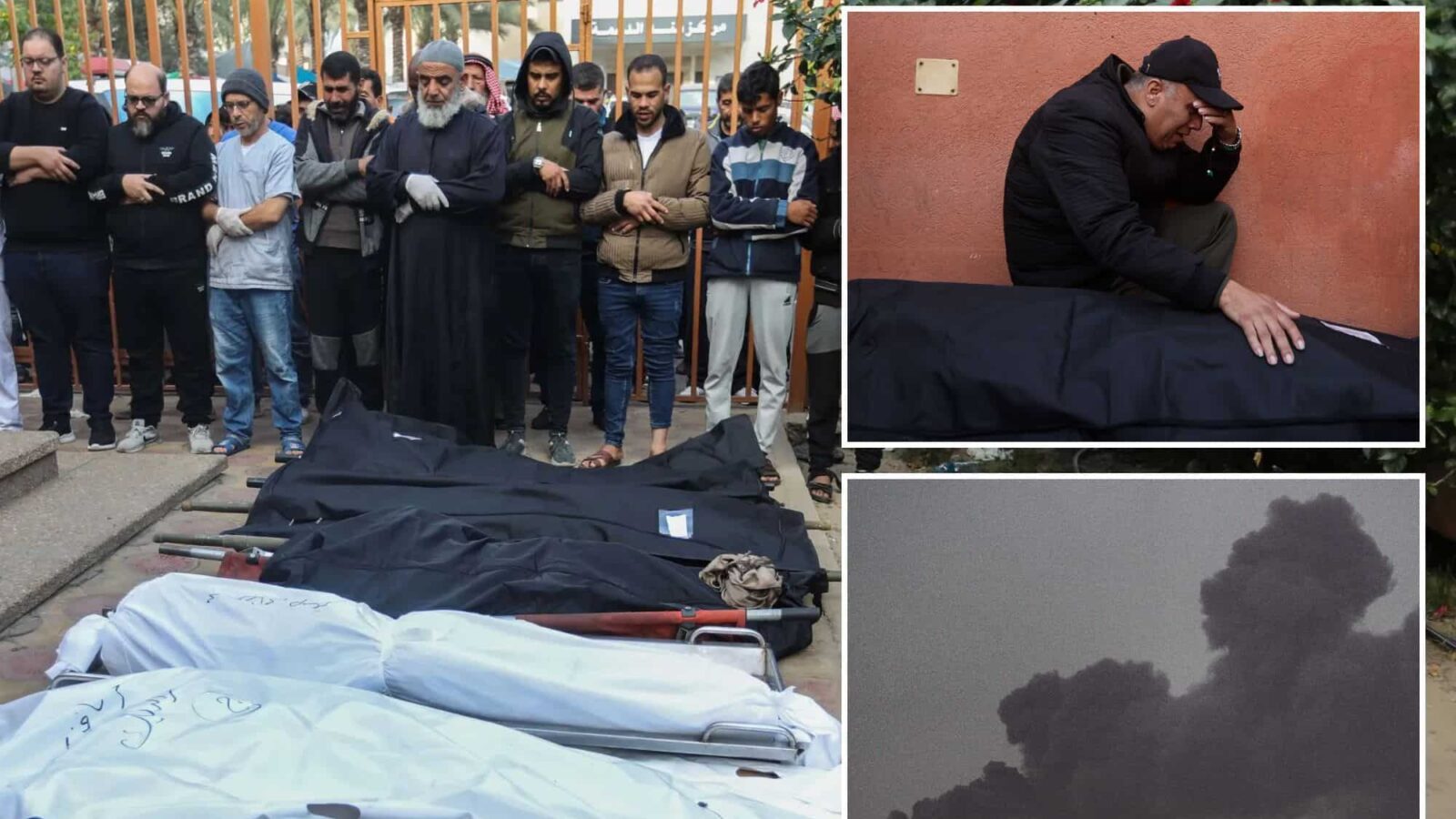
Friday’s strike on a building in Gaza City was among the deadliest of the Israel-Hamas war, now in its 12th week, said Mahmoud Bassal, a spokesman for Gaza’s Civil Defense Department.
He provided a partial list of the names of those killed — 16 heads of households from the al-Mughrabi family — and said the dead included women and children.
Among the dead were Issam al-Mughrabi, a veteran employee of UN Development Program, his wife, and their five children.
“The loss of Issam and his family has deeply affected us all. The UN and civilians in Gaza are not a target,” said Achim Steiner, the head of the agency. “This war must end.”
Israel declared war after Hamas terrorists stormed across the border on Oct. 7, killing some 1,200 people and taking some 240 hostages.
Israel has vowed to keep up the fight until Hamas is destroyed and removed from power in Gaza and all the hostages are freed.
More than 20,000 Palestinians have been killed in Israel’s war to destroy Hamas and more than 53,000 have been wounded, according to health officials in Gaza, a besieged territory ruled by the Islamic militant group for the past 16 years.
Israel blames Hamas for the high civilian death toll, citing the group’s use of crowded residential areas for military purposes and its tunnels under urban areas.
It has unleashed thousands of airstrikes since Oct. 7, and has largely refrained from commenting on specific attacks, including discussing the intended target.
On Friday, the UN Security Council adopted a watered-down resolution that calls for immediately speeding up aid deliveries to desperate civilians in Gaza.
The United States won the removal of a tougher call for an “urgent suspension of hostilities” between Israel and Hamas. It abstained in the vote, as did Russia, which wanted the stronger language.
Stay on top of news out of the Israel-Hamas war and the global surge in antisemitism with The Post’s Israel War Update, delivered right to your inbox every Monday, Wednesday and Friday.
The resolution was the first on the war to make it through the council after the US vetoed two earlier ones calling for humanitarian pauses and a full cease-fire.
Stay on top of news out of the Israel-Hamas war and the global surge in antisemitism with The Post’s Israel War Update, delivered right to your inbox every Monday, Wednesday and Friday.
UN Secretary-General Antonio Guterres reiterated his longstanding call for a humanitarian cease-fire. He expressed hope that Friday’s resolution may help this happen but said “much more is needed immediately” to end the ongoing “nightmare” for the people in Gaza.
He told a news conference that it’s a mistake to measure the effectiveness of the humanitarian operation in Gaza by the number of trucks.
“The real problem is that the way Israel is conducting this offensive is creating massive obstacles to the distribution of humanitarian aid inside Gaza,” he said.
He said the prerequisites for an effective aid operation don’t exist — security, staff that can work in safety, logistical capacity especially trucks, and the resumption of commercial activity.
Israel’s aerial and ground offensive has been one of the most devastating military campaigns in recent history, displacing nearly 85% of Gaza’s 2.3 million people and leveling wide swaths of the tiny coastal enclave.
More than half a million people in Gaza — a quarter of the population — are starving, according to a report this week from the United Nations and other agencies.
Shielded by the Biden administration, Israel has so far resisted international pressure to scale back. The military spokesman, Rear Adm. Daniel Hagari, said late Friday that forces are widening the ground offensive “to additional areas of the strip, with a focus on the south.”