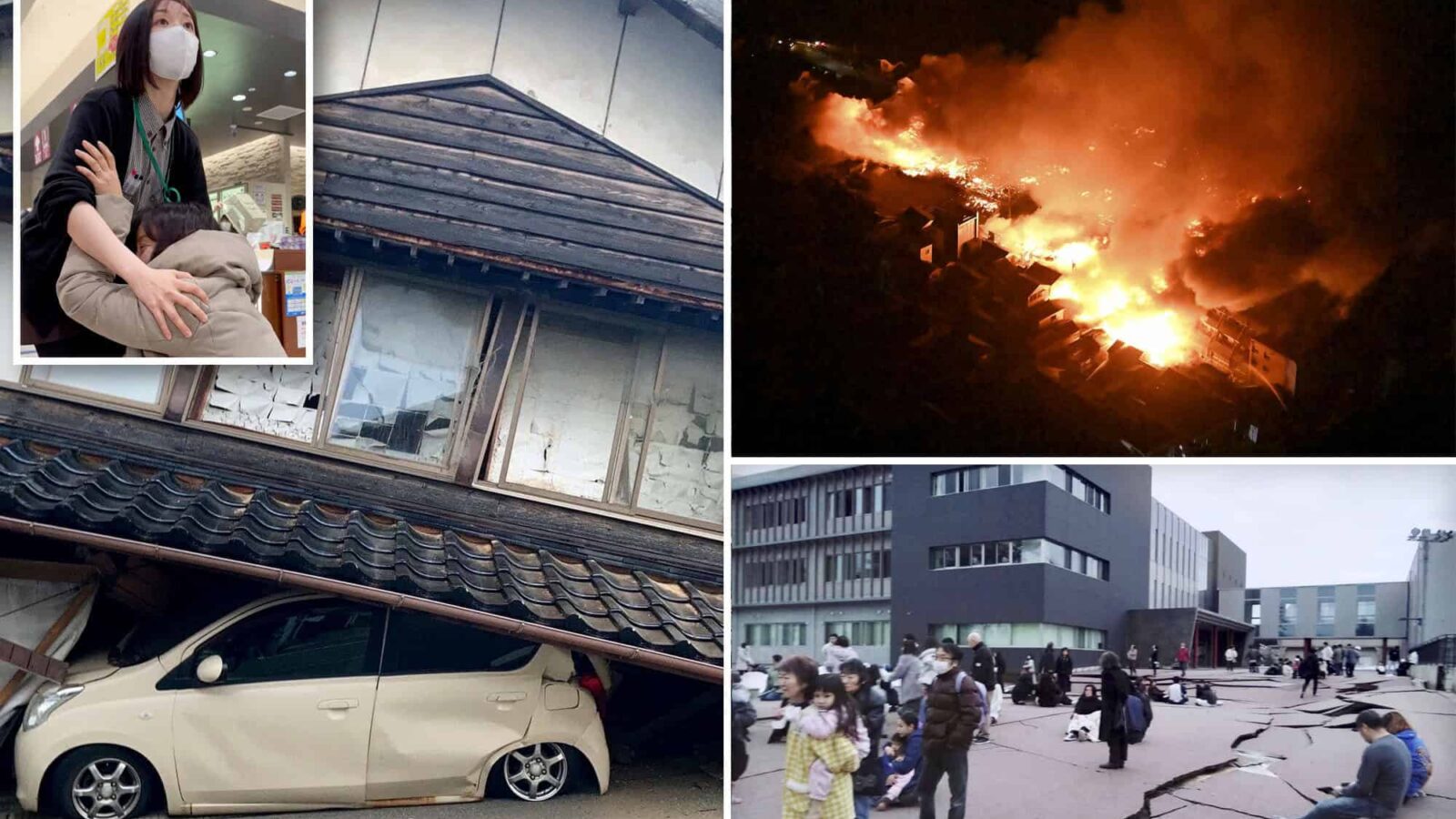
More than a dozen quakes were reported off the coast of Ishikawa shortly after 4 p.m., the largest of which was measured at 7.5. magnitude, according to the Japan Meteorological Agency, which issued a major tsunami warning for Ishikawa and lower-level warnings or advisories for the rest of the western coast on the island of Honshu.
The tremors first caused four foot tall waves to strike coastal cities, where residents were urged to immediately get to high ground ahead of expected waves of up to 17 feet tall, according to the broadcaster NHK TV.
As a result, warnings were aired continuously nearly an hour after the initial alert.
The area under tsunami threat includes a nuclear plant.
“Every minute counts. Please evacuate to a safe area immediately,” Government spokesman Yoshimasa Hayashi said.
A ten foot high tsunami was expected to hit Niigata and other western coastal prefectures, where large waves had already reached land.
At least six homes were damaged by the quakes, trapping their occupants inside, Hayashi said.
A fire in Wajima city connected to the disaster had also left some 30,000 households in the dark, according to the spokesperson.
Several buildings were damaged and roads were cracked by the initial earthquake, and some of the country’s famous Shinkasen bullet trains were also suspended as residents fled to safety, CNN reported.
“In response to the M7 earthquake at Noto region in Ishikawa prefecture, we have immediately set up the Prime Minister’s Office of Response – Disaster Counter Measure HQ,” Japanese Prime Minister Fumio Kishid wrote on X.
“Putting human lives as priority, we are making every effort to assess damages — putting forth all efforts in disaster response. For those in affected areas, please pay close attention to the latest information and place personal safety as your priority.”
A tsunami threat has also been declared in the eastern Russian cities of Vladivostok, Nakhodka, and the island of Sakhalin, CNN reported, citing the Russian state media TASS.
Japan is an extremely earthquake-prone country. In March 2011, a major quake and subsequent tsunami killed nearly 20,000 people and caused meltdowns at a nearby nuclear power plant.
A tsunami threat has also been declared in the eastern Russian cities of Vladivostok, Nakhodka, and the island of Sakhalin, CNN reported, citing the Russian state media TASS.
With AP wires