Everything costs money in today’s NYC — even making a friend.
Every day, from packed subway cars to pedestrian-choked sidewalks, go-go Gothamites are surrounded by millions of other people wondering how to find more meaningful friendships — forever a challenge in this fast-paced city, and now even more so in the smartphone-obsessed modern age.
To bridge (and tunnel) the widening connection gap, Big Apple bond-hunters are increasingly banking on a growing number of paid pal-finding services — hoping to foster new platonic relationships.
These apps and websites are bringing New Yorkers together IRL, beating back the ongoing loneliness crisis — and in some cases, even spurring serious connections.
After going through a devastating breakup in early 2025, Manhattan-based gynecologist Lauren, 33, decided to give a friend-making service a shot, hoping to assuage some of the isolation she felt from being the only single gal in her friend group.
“I realized my circle of girlfriends was made up of mostly people in relationships,” she told The Post, asking that her last name not be used. “I really wanted to meet some girls in the city who had the shared experience of being single in NYC that I could commiserate and go out with.”
After seeing one too many Instagram ads, Lauren took a chance on 222 — a company that prides itself on connecting like-minded users by utilizing an in-depth questionnaire to connect potential friends through a smorgasbord of shared group experiences.
The cost of participation is $17 per event (or a monthly membership of $22, which waives the event fees) — plus the cost of food and drink.
Before attending a 222 event, a small group of like-minded users is matched for dinner or drinks after filling out an in-depth personality assessment, which features questions like “Would you rather go clubbing or have a daytime picnic?”
The matched group is then attends a follow-up activity — where the pendulum can swing from bull riding at a country bar to laughing it up at a comedy show — to meet the rest of the 222 crowd.
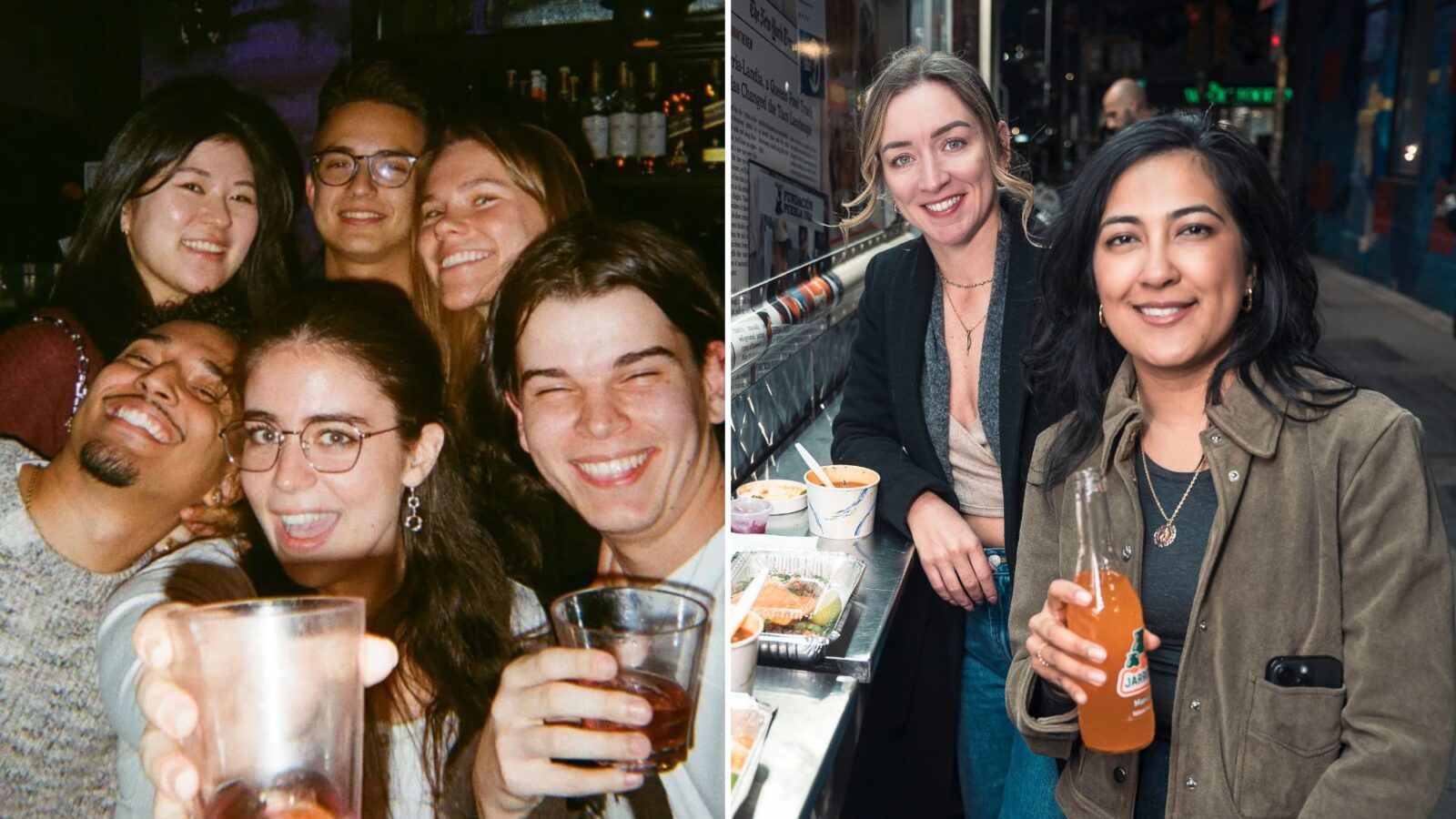
Luckily for Lauren, she quickly found what she was looking for — a then-fellow single friend, Izzy U., 28, who would quickly become one of her ride-or-dies.
“222 was the only friend-making service that I ended up trying, because it was immediately very successful,” Izzy, who asked to withhold her last name due to the sensitive nature of her job, told The Post. “I felt like I had been in the city for a really long time and had struggled to meet people outside of work…I wanted to branch out and meet new people, and this felt like the best way to do that.”
Izzy also helped connect Lauren with her future husband and will officiate her pal’s wedding.
“222 was the only friend-making service that I ended up trying, because it was immediately very successful,” Izzy, who asked to withhold her last name due to the sensitive nature of her job, told The Post. “I felt like I had been in the city for a really long time and had struggled to meet people outside of work…I wanted to branch out and meet new people, and this felt like the best way to do that.”
“I was lamenting online dating to Izzy and showed her (my now fiancé’s) profile to ask if we should go on a date,” Lauren recalled. “She actually remembered him from work and told me they had worked on a project together years ago — and vouched for him when I was planning to cancel the date.”
While friend-making apps and services like 222 have been viewed as a somewhat niche avenue to meet new people, the category is growing quickly — and there are now a ton to choose from, with varying event price points.
Kindred and Timeleft focus on bringing small groups of strangers, fewer than 10, together for curated group activities. Parlour Social Club and Clockout are dual-designed for professional networking. RealRoots is female-focused and encourages members to invest time and attention into the same small group of women for six weeks in the hopes of creating long-lasting bonds.
Meetup.com brings small groups of users together based on specific interests, like meditation or trivia, while Bumble BFF allows users to swipe on each other for a potential friend match, the same way they would for potential love interests.
Lauren Tetenbaum, LCSW, an NYC psychotherapist and author who specializes in supporting women through life transitions, views friend-making apps and services as an effective way to meet people with shared interests, since organically meeting someone new feels like an almost impossible feat nowadays.
“Solid friendships or even just moments of bonding can reduce stress, boost self-esteem and protect against anxiety or depression,” she continued. “When we feel lonely or compare our social lives to curated (online) feeds, we tend to feel lost, sad and disconnected — like something is wrong with us,” Tetenbaum told The Post.
“Some people may be reluctant to try these apps because they seem untraditional — but just as dating apps have become mainstream, friendship apps can be life-changing and lead to really fulfilling relationships,” the expert pointed out. “It’s important to be open-minded about who you might connect with and why. You never know how deep a connection can go, but it’s worth trying to reduce loneliness or build your network with a bit of fun.”