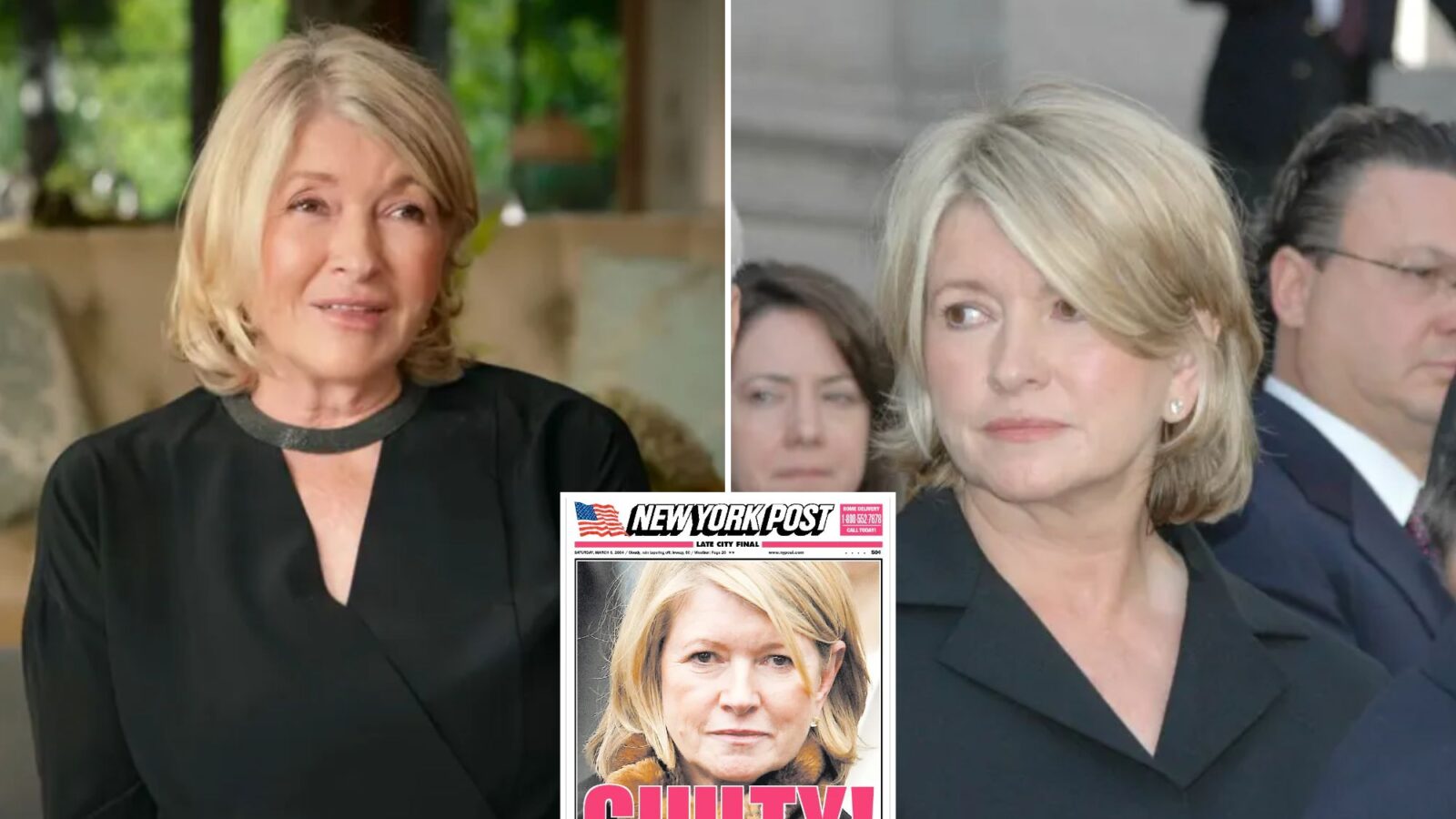
Her comments come during a section of the film that focuses on her federal obstruction of justice trial and five-month stint in prison beginning in 2004 — five years after Stewart, 83, became the first self-made female billionaire in 1999.
“It was so horrifying to me that I had to go through that to be a trophy for these idiots in the U.S. Attorney’s office,” she says in the Netflix documentary called “Martha,” which was released on Oct. 30.
Comey, who was behind the now-defunct 2016 Russia investigation into Donald Trump that the former president dubbed a “witch hunt,” was the lead prosecutor who indicted Stewart on charges of obstruction of justice and lying to the FBI in 2003. The charges came in connection with the FBI’s insider trading investigation into her friend’s company, ImClone.
“I was a trophy — a prominent woman, the first billionaire woman in America,” Stewart says of the case in “Martha.”
When charges were initially filed against Stewart, then 62, then-U.S. Attorney Comey said during a 2003 news conference that the “case is about lying — lying to the FBI, lying to the SEC and investors.”
“That is conduct that will not be tolerated. Martha Stewart is being prosecuted not because of who she is, but what she did,” he said at the time.
Meanwhile, Stewart’s attorney, the late Robert Morvillo, questioned whether the charges were filed “for publicity purposes or because Martha is a celebrity” in a statement after the indictment was filed.
“Is it because she is a woman who has successfully competed in a man’s business world by virtue of her talent, hard work and demanding standards?” Morvillo asked. Stewart had made her fortune off her media company, Martha Stewart Living Omnimedia Inc., which she founded in 1997.
Craig Greening, managing partner of Greening Law Group and a criminal defense attorney, told Fox News Digital that the “Southern District of New York is notorious for prosecuting high-profile individuals and leveraging their cases to send a broader message.”
“Martha Stewart’s case fits this pattern,” Greening said. “The prosecution’s pivot to obstruction of justice when insider trading charges couldn’t stick highlights a strategy often used to hold public figures accountable in highly visible ways.”
Greening added that the charges filed against Stewart “were valid given the evidence.”
“However, the question of proportionality remains. Stewart served five months in prison and five months under home confinement—not insignificant penalties for a 1001 violation,” he explained. “One could argue that her punishment felt more about creating an example than ensuring justice, which fuels the debate over fairness in her case.”
Greening said it’s a common tactic for the government to “shift to obstruction-of-justice” charges when “the primary charge is difficult to prove.”
“However, the question of proportionality remains. Stewart served five months in prison and five months under home confinement—not insignificant penalties for a 1001 violation,” he explained. “One could argue that her punishment felt more about creating an example than ensuring justice, which fuels the debate over fairness in her case.”
Morning Report and Evening Update: Your source for today’s top stories
Please provide a valid email address.
By clicking above you agree to the Terms of Use
and Privacy Policy.
Never miss a story.
“In Stewart’s case, this approach allowed the prosecution to maintain accountability, but it also underscores the role of discretion in targeting public figures,” Greening said.
In an Oct. 31 interview with The New York Times, following the official premiere of “Martha” on Netflix, the media mogul said she enjoyed the first half of the film but described the second half as “a bit lazy.” Her trial, she said, was “not that important.”
“The trial and the actual incarceration was less than two years out of an 83-year life,” Stewart told the Times. “I considered it a vacation, to tell you the truth.”