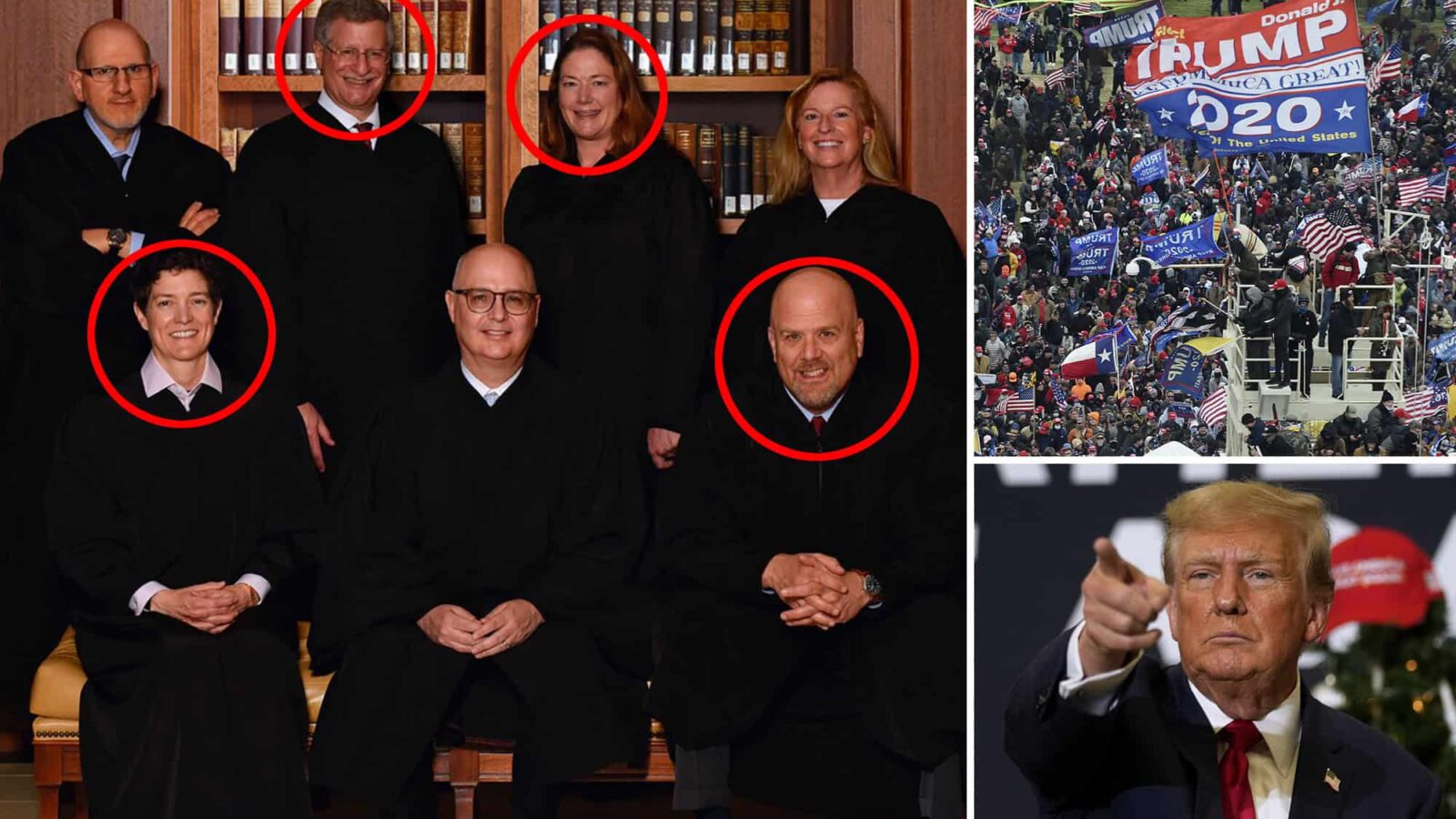
The Democrat-appointed justices who made the decision include three Ivy League graduates — two of whom were wrongfully accused of harassment and discrimination — as well as the first Latina and openly gay woman to serve on Colorado’s highest court.
Their ruling marks the first time in history that Section 3 of the Fourteenth Amendment — which disqualifies insurrectionists from office — has been used to ban a presidential candidate from appearing on the ballot.
Together, Justices Richard L. Gabriel, Melissa Hart, Monica Márquez and William W. Hood III said they had ”little difficulty” in determining that the events of Jan. 6 constitute an insurrection and that Trump did “engage” in the alleged rebellion.
Below, The Post delves into the careers of the four justices who formed the majority opinion.
Richard L. Gabriel, a native of Brooklyn, New York, was appointed to the Supreme Court in June 2015, following a career in commercial and intellectual property law, according to his biography on the Colorado Judicial Branch’s website.
He graduated from Yale University, earning a Bachelor of Arts degree in American Studies, and went on to obtain his law degree from the University of Pennsylvania.
In a 2018 judicial performance review, attorneys wrote that “Justice Gabriel’s performance is strong in the areas of being prepared for oral argument, being courteous and treating parties equally.
“The Commission believes that Justice Gabriel is a valuable asset to the Supreme Court,” the Office of Judicial Performance Evaluation Commission concluded.
A few years later, in 2021, a female law clerk accused Gabriel of harassment, the Denver Post reported at the time.
But an external organization that was called in to investigate the claims of harassment and gender discrimination determined that the accusations were unfounded.
Justice Melissa Hart was appointed to the bench in December 2017, and serves as an adjunct professor at the University of Colorado Law School and the University of Denver’s Sturm College of Law, according to her bio.
She went to Harvard-Radcliffe for her undergraduate degree, and then returned to Harvard for her law studies.
She maintains an active pro bono practice, and continues to actively represent clients even as she serves on the bench.
She went to Harvard-Radcliffe for her undergraduate degree, and then returned to Harvard for her law studies.
A 2020 Office of Judicial Performance Evaluation found that she is “fair and impartial, makes decisions without regard to possible criticism and treats parties equally, regardless of race, sex or economic status.”
In September, Hart even warned attorneys about the barriers people face in accessing Colorado’s justice system as she unveiled the Colorado Judicial Department vision, Colorado Politics reports.
It says: “We commit to acting with integrity, fairness and transparency. And we commit to being inclusive, collaborative and innovative.”
But Hart said the judicial branch is “not there yet,” according to Colorado Politics.
Hart has also been accused of discrimination in a lawsuit filed by a black job applicant.
Michele Brown accused the justice and other judges of engaging in racial and age discrimination when they refused to hire her as a rules attorney, the Denver Post reports.
But a federal judge threw out the case after finding no evidence of discrimination.