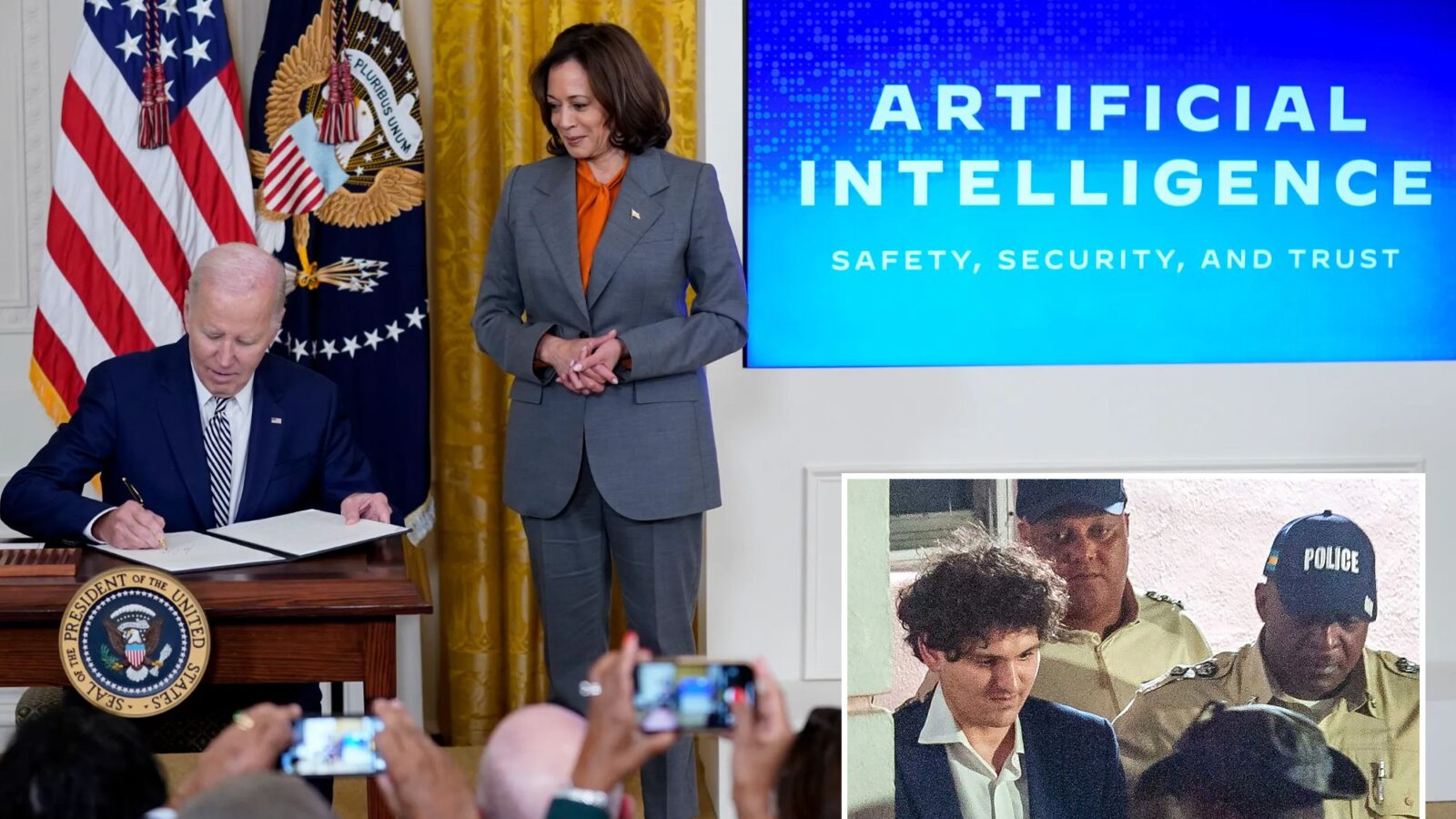
Dustin Moskovitz, Mark Zuckerberg’s Harvard dorm mate, is paying the salaries of a group of aides in the White House’s National Security Council, the Pentagon and the Department of Commerce in an arrangement which puts advocates of the movement at the heart of government.
“Effective altruism” (known as EA) has gained billionaire Silicon Valley followers for its philosophy of encouraging people to make as much money as possible then turn to giving it to what it sees as noble causes.
The movement’s leaders include Moskovitz and wife Cari Tuna and Skype’s Estonian co-founder Jann Tallinn, while Elon Musk has said that while he is not a follower or funder, it is a close match for his philosophy.
But it was plunged into crisis by the fall its most high-profile advocate, jailed former crypto-king Sam Bankman-Fried.
Now movement it is quietly trying to re-build ties to power, including at the heart of the White House — and the roles reflect the effective altruism’s growing interest in AI, which its leaders have spoken out against.
The key funder of the bid to have its followers in the White House is 39-year-old Moskovitz, whose Facebook fortune is worth $18 billion, runs Open Philanthropy, which in turns distributes cash to a network of associated think tanks and projects.
One of those non-profits, the Center for Emerging Technology at Georgetown University, known as CSET — to which Open Philanthropy gave $55 million — is paying the salaries of the “fellows” who hold government roles with high-level security access.
Among the fellows is Andrew Lohn, the National Security Council’s director for “emerging technology.”
The other fellows they are paying for — the salaries they receive are undisclosed — also have roles which appear close to government work on AI.
Diana Gelhaus, a CSET fellow, currently serves as the senior advisor for talent in the chief digital and Artificial Intelligence office at the Department of Defense, giving her a crucial say in who the Pentagon hires for AI projects.
Emily Weinstein serves as a senior advisor in the office of the Undersecretary of Industry and Security at the Department of Commerce.
Will Hunt, a former CSET staffer, served as a special advisor to the CHIPS Act office at the Department of Commerce. The CHIPS Act aims to bring semiconductor manufacturing back to the US particularly for AI computing.
They are able to be paid by the outside non-profit through a little-known law, the Intergovernmental Personnel Act of 1970, that facilitates short-term hiring of outside experts, bypassing normal procedures.
Will Hunt, a former CSET staffer, served as a special advisor to the CHIPS Act office at the Department of Commerce. The CHIPS Act aims to bring semiconductor manufacturing back to the US particularly for AI computing.
“I view these fellowships as an important training opportunity for researchers, which is why CSET funds one-year fellowships for our personnel in line with established procedures, such as the Intergovernmental Personnel Act,” Dewey Murdick, the executive director of CSET, said in email to The Post.
A spokesman for Open Philanthropy said the organization is removed from CSET’s work — and said that the staffers in the Biden administration were not necessarily EA ideologues.
“While Open Philanthropy is proud to have supported Georgetown’s research on things like how AI can be used in national security settings, it wouldn’t be appropriate to take credit for an independent grantee’s programmatic decisions,” Mike Levine, a spokesman for Open Philanthropy told The Post.
“CSET is fully in charge of hiring, research, regranting, and collaborations with others in academia and government, including via fellowships. We had no involvement in any of these secondments.”
The National Security Council did not respond to a request for comment.
But critics say that proponents of EA are being given an inside track on AI regulation, at the same time as companies with ties to the EA movement are seeking to make money in the area.
A current trend being pushed in AI governance is to pre-test or “audit” companies’ AI models.