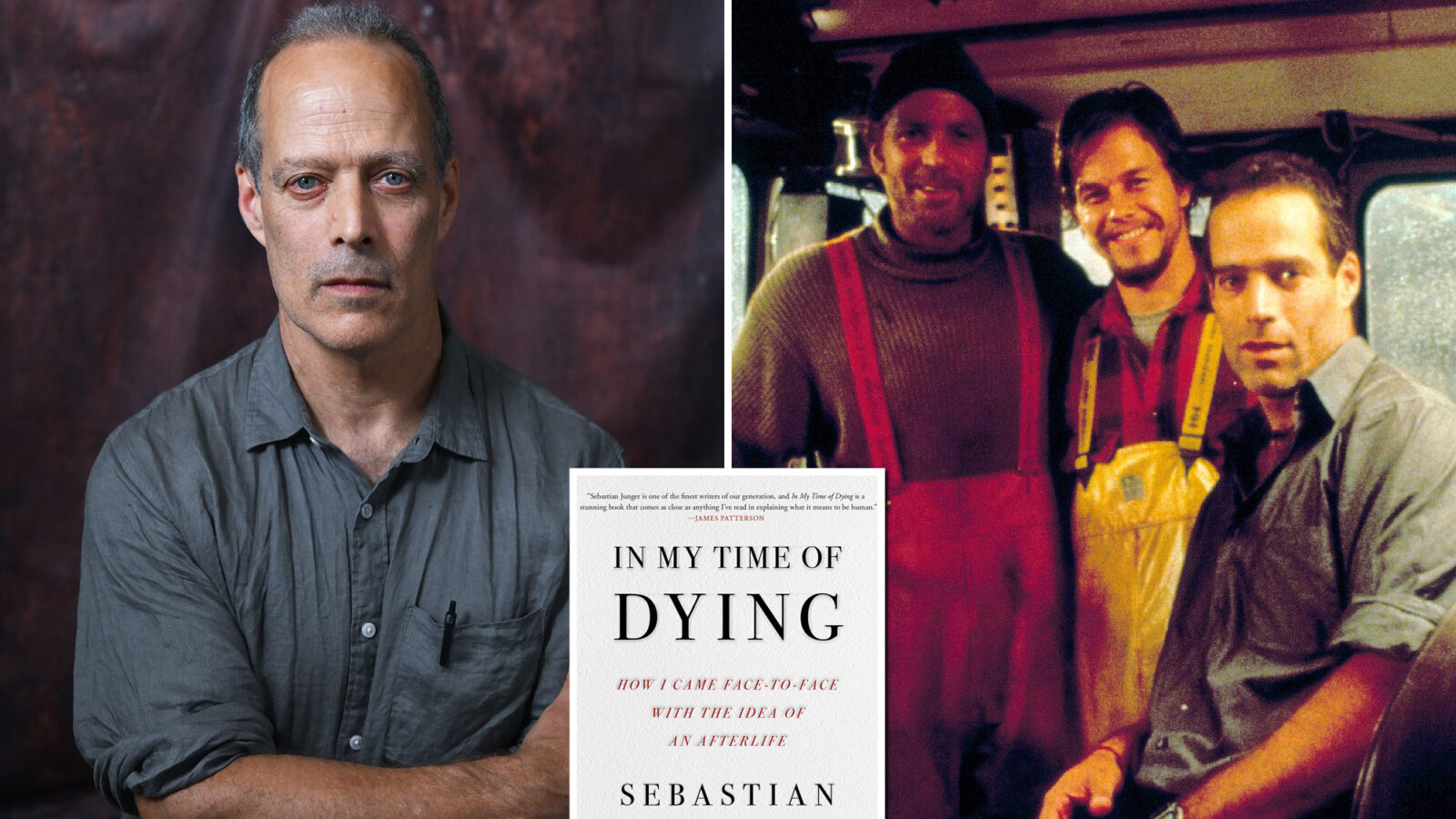
Sebastian Junger was dying — fast.
For decades, the famed author, journalist and filmmaker had told the stories of men facing down their own deaths — be it on the decks of the doomed Andrea Gail, which he chronicled in 1997’s hit book and flick “The Perfect Storm,” or on the battlefields of Kosovo, Bosnia, Sierra Leone and Afghanistan, which he visited during his lengthy career as a war reporter.
But on that day in June 2020, the reaper reached out to him directly — in the form of a ruptured abdominal aneurysm.
The avowed atheist watched as disturbing, nearly supernatural scenes unfolded before his eyes — startling images he details in his new book, “In My Time of Dying: How I came Face to Face with the Idea of an Afterlife.”
A deep, black chasm opened on the floor next to his hospital gurney, the 62-year-old Junger told The Post. Then, his long-dead father appeared overhead, whispering words of comfort.
Junger, the father of two little girls, told the doctors in a panic, “You’ve got to hurry.
“You’re losing me right now.”
The doctors did hurry, and Junger survived. But the experience shook him to his bones, and an avalanche of anxiety and depression swept over him as he realized the long arm of death could extend far beyond the battlefield.
“It was devastating,” said Junger, who primarily lives with his family in Lower Manhattan, to The Post. “It completely undid my sense of there being stability and safety in the world — which war zones didn’t because of course I knew inherently that they’re dangerous and I was choosing to go to them.
“So what was really disconcerting was to then be sort of tracked down by the threat of death,” Junger said. “And it found me in the safest place imaginable: Deep in the woods in my home [on Cape Cod]. It really pulled the rug out from under me.”
So Junger did what authors do: He wrote the book, released May 21,in which he tried to make sense of the nonsensical and put the fantastical into perspective.
But the tome — which has stayed inside the top 10 on the New York Times’ bestseller list for hardcover nonfiction — is not the tale of a hard-bitten journalist who suddenly casts aside his atheistic ways in tragedy’s wake.
In fact, it’s quite the opposite: Junger said the slim, 176-page work is an ode to the power and beauty of rational thought. And he hopes it imparts the reader with “a kind of reverence for life” they may otherwise be ignoring.
But the tome — which has stayed inside the top 10 on the New York Times’ bestseller list for hardcover nonfiction — is not the tale of a hard-bitten journalist who suddenly casts aside his atheistic ways in tragedy’s wake.
“Many people get to that reverence through religion, but you don’t need to,” the author said. “And one of the things that almost dying made me realize was that I was alive. We’re all at risk of not appreciating that sufficiently.”
Junger’s tendency to brush aside the notion that a higher power intervened to save his life has rubbed some of his more devout readers the wrong way.
“I’ve had a little bit of hectoring from people at readings who say, ‘You survived by the grace of God, you’re being ungrateful,’ and nonsense like that,” Junger said. “But for me, the mystery of seeing my father points to something far more mind-blowing than religion.
“Religion comes up with rather prosaic explanations for things, like there’s a guy up above us with a beard, sort of stage directing everything and judging us,” he said. “And I’m like, the fact that the universe exists and is 93 billion light years wide and came from nothing — that’s actually the great mystery that we’re here to contemplate it.
“Let’s just stop for a moment and consider how stunning that is and that we’re part of this,” Junger said. “It brought that into focus.”
But he doesn’t pretend to know all the answers.
In fact, despite his aversion to religion and all its trappings, Junger said the near-death experience also made him wonder if even the physicists “really know what the hell’s going on.”