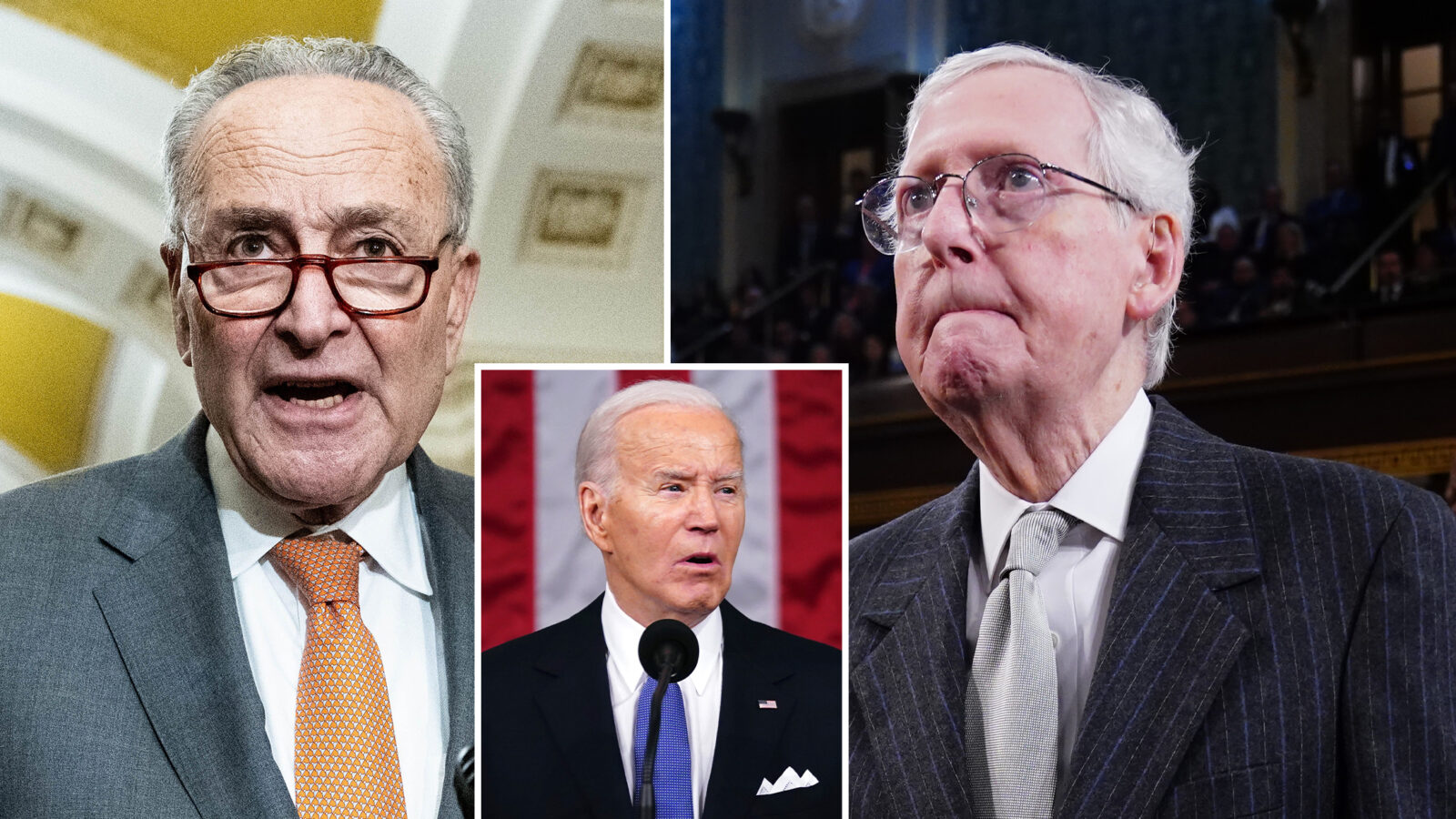
The package passed 75-22, with 21 Republicans voting in opposition and just one Democrat.
The upper chamber voted 63-35 early in the afternoon to limit debate on the package that would keep roughly the same funding levels until Sept. 30 for the Departments of Veterans Affairs, Agriculture, Transportation, Commerce, Justice and Housing and Urban Development, as well as the Food and Drug Administration and military construction.
However, it took several more hours for senators to agree on what amendments should be considered in exchange for dispensing with the required 30 hours of debate time before a final vote on passage.
Ultimately, Senate Majority Leader Chuck Schumer (D-NY) agreed to consider amendments pitched by four Republican senators: Mike Lee of Utah, Eric Schmitt of Missouri, Rick Scott of Florida, and Bill Hagerty of Tennessee. All four amendments failed.
“After months of hard work, we have good news for the country,” Schumer said in announcing the vote series. “We will keep important programs funded for moms and kids, for veterans, for the environment, for housing and so much more.”
Senate president pro tempore Patty Murray (D-Wash.), the upper chamber’s top appropriator, hailed the provisions in the final text for “protecting vital funding” while avoiding a “senseless shutdown.”
Murray and other Democrats also celebrated a $1 billion increase to the women, infants and children (WIC) food program for low-income applicants, as well as having warded off Republican policy riders, including a ban on access to the abortion pill mifepristone.
Conservative Senate Republicans opposed the package for containing more than 6,000 earmarks, with Lee referring to it as the “Schumer minibus” — despite Senate Minority Leader Mitch McConnell (R-Ky.) and 13 Republicans the procedural vote.
“I would urge my colleagues to stop playing with fire here,” top Republican appropriator Susan Collins of Maine said on the Senate floor. “The House, controlled by Republicans, passed these bills as a package, the six bills, with a very strong bipartisan vote, with the majority of the majority voting for them.
“It would be irresponsible,” Collins added, “for us not to clear these bills and do the fundamental job that we have of funding the government.”
As part of a side deal struck during last May’s debt ceiling fight, a 1% government-wide cut on discretionary spending would go into effect on April 30 if the House and Senate pass a continuing resolution to fund the government at current levels until September.
That approach would cut federal spending by $130 billion, according to Lee, who tried to block the appropriations bills on the Senate floor, but was voted down 52-45.
The House of Representatives approved the 1,050-page bill 339-85 Wednesday. It requires 60 votes to clear the Senate.
That approach would cut federal spending by $130 billion, according to Lee, who tried to block the appropriations bills on the Senate floor, but was voted down 52-45.
Funding for the Pentagon, Homeland Security, Health and Human Services and the State Department will run out at 11:59 p.m. March 22 if another spending package isn’t passed.
In a joint statement last month, Schumer, Murray and McConnell vowed the spending would be enacted on time.
House Speaker Mike Johnson (R-La.) split the traditional 12 appropriations bills to fund the government into two packages after having expressed optimism about returning Congress to regular order — a feat not accomplished since 1996.
“Even with divided government and a historically small House majority, House Republicans have worked hard to successfully move the policy and spending priorities of the federal government away from the previous Pelosi-Schumer FY23 appropriations, and American taxpayers will benefit from it,” Johnson said in a statement after the first six bills passed earlier this week.
In January, Johnson and Schumer negotiated a $1.66 trillion topline for federal spending in fiscal year 2024.
The US national debt currently sits at $34.4 trillion, with deficit spending of $532 billion so far in fiscal year 2024, according to the Treasury Department. Inflation has cooled to around 3%, Bureau of Labor Statistics data show, but remains above pre-pandemic levels.
“Pork barrel spending elicits images of politicos, fistfuls of cash to be passed out to the special interests,” libertarian-minded Sen. Rand Paul (R-Ky.) said in a floor speech before the vote, calling out several earmarks that had raised eyebrows for fiscal hawks.